To: Subscribers of Not only Swift
Date: February 20, 2026
Issue: 94
Re: The Swift Programming Language Book goes to print, Agentic Coding, and On-Device Vector Databases
Hi, everyone!
A while ago, I created a typeset version of the Swift Programming Language book. I mostly did this to verify that the Typst template I created for a book I am working on at the moment works well.
Imagine my surprise when Jace T. Chan shared on BlueSky that he’d actually gone through the trouble of finding a printer that would print the book for him.
He even shared a couple of beautifully shot photos of the result:
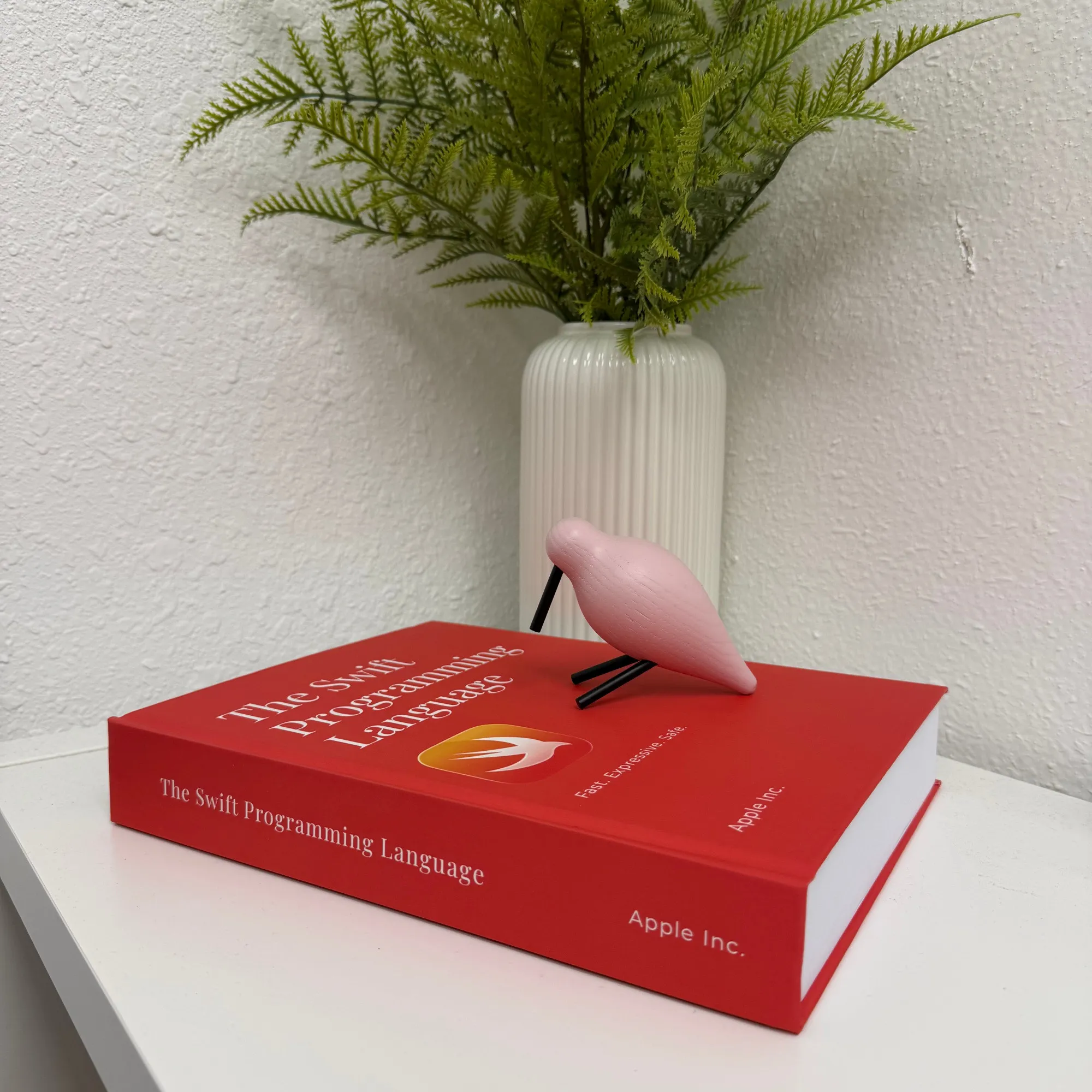
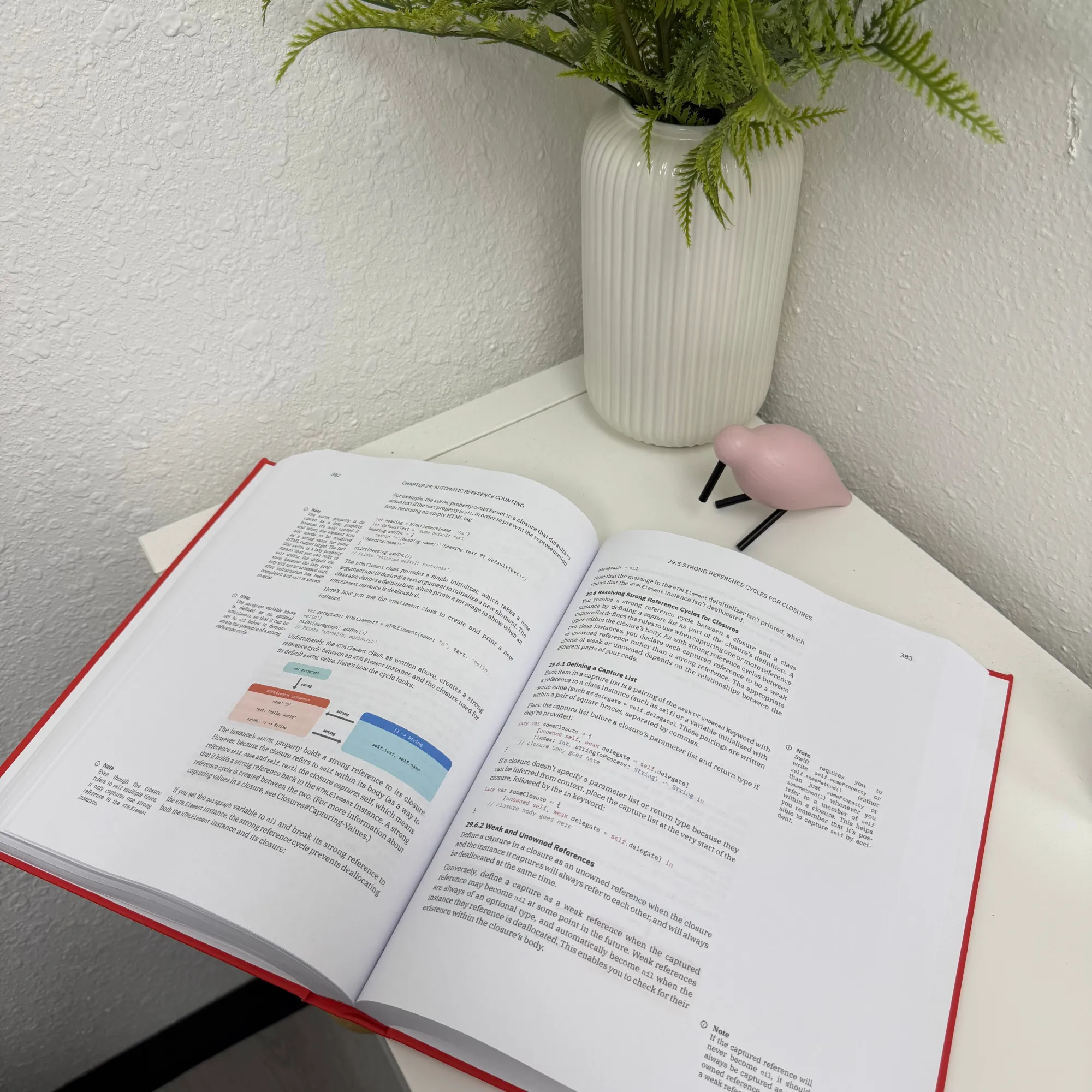
Doesn’t it look absolutely fabulous? Read the thread to find out more about the printing process. Printing a one-off copy of the book wasn’t particularly cheap, but it wasn’t much more expensive than most other tech books you can buy.
If you’d like your own copy of the book, you can get the PDF for free from this repo.
And with that - back to our regular programming of Swift, SwiftUI, and AI! In this issue, we’re looking at a couple of MCP servers that make working with Apple’s documentation easier, and we explore the question of whether it’s possible to build software without writing a single line of code.
Thanks for being a subscriber! If you want to reach out to me, just hit reply - I read all emails you send me, and I’d love to hear from you.
Cheers,
Peter
by Peter Friese
Can AI agents actually build complex features in a real-world SwiftUI app? In this livestream, I let multiple instances of the Antigravity coding agent refactor and implement new features in parallel.
I set up a git worktree for each of the features, discussed the implementation plan with Antigravity, and let the agents get to work.
At the end of the stream, they had finished implementing a substantial UI refactoring, and implemented another feature from scratch.
If you’re curious about using agentic coding for your own projects in general, or how to set up Antigravity for multi-agent Swift / SwiftUI development, this is for you!
by Peter Friese
With Xcode 26.3, Apple entered the agentic coding space. In addition to the built-in support for Claude Code and Codex, they provide an MCP bridge that allows you to connect any MCP-compliant coding agent to Xcode.
However, when Peter gave this a try with Gemini CLI, Peter ran into an issue where Xcode’s responses weren’t compatible with the MCP protocol. So instead of waiting for Apple to fix this, Peter implemented a fix on our end.
The article walks you through the steps required to connect Gemini CLI to Xcode 26.3, and demonstrates how to build a SpriteKit game using agentic coding.
by Rudrank Riyam
An entirely local, on-device, vector database written in Swift. It allows you to implement on-device semantic search, recommendation systems, and other AI-powered features in your Swift apps.
Thanks to a pluggable architecture, you can use your own storage and search engine providers, allowing for integration with cloud-based backends.
Great work by Rudrank!
by Miguel de Icaza
Pi is the agent framework that powers Moltbot. It allows you to create agents that can reason about tasks, plan actions, and execute them. Miguel needed a Swift port of the framework for an iPad app he’s working on (now I’m curious what that app is…), and here it is.
Subagents are defined as Markdown files, which makes it easy to create and manage them.
by Luki Labs
Mermaid is a diagramming tool that uses Markdown-like syntax to create diagrams. It’s a great tool for creating flowcharts, sequence diagrams, and other types of diagrams.
The only downside is that… they usually don’t look that great. Luki Labs, the company behind Craft, built Beautiful Mermaid for their Craft Agents tool. And since porting code from one language to another is no longer a big challenge thanks to AI, they decided to build a Swift version.
So if you ever wanted to render Mermaid diagrams in your Swift app without having to depend on WebView or JavaScript, now you can.
by Sungwhee Kim
Large Language Models have a cut-off-date - the date when the training run was finished. Typically, this is several months in the past, resulting in a knowledge gap for the model. (This is the reason why many LLMs think that iOS 26 and Xcode 26 don’t exist!)
To work around this knowledge gap, we can give our coding agents access to the relevant documentation, for example by connecting them to an MCP server that can search the relevant documentation.
Starting with version 26.3, Xcode includes an MCP server that - among other things - is capable of searching Apple’s developer documentation.
If you don’t want to use the Xcode MCP server, you can use Sungwhee’s standalone MCP server instead - it’s independent of Xcode, and provides access to the same documentation: iOS/macOS/SwiftUI/UIKit docs, WWDC videos, Swift/Objective-C APIs, as well as code examples.
This implementation does NOT store an offline copy of the documentation. Instead, it downloads the documentation on the fly when needed.
by Mihaela MJ
Here is another MCP server for Apple Developer Documentation, written in Swift. Instead of accessing the documentation on demand, it downloads the documentation for offline use, and generates an index for fast searching.
by Mattt
I know I’ve covered sosumi before, but since this issue of the newsletter contains a bunch of documentation MCP servers, I felt it’s only right to also include sosumi.
Besides, Mattt mentioned that it now also supports third party DocC documentation sites as well, which is great news!
by Ryan Lopopolo
Can you write code without actually writing code? One team at OpenAI decided to find out—they started with an empty repo, setting themselves the rule of only writing prompts for Codex.
Apparently, they succeeded - all code, including any infrastructure code required for CI/CD, is written by agents.
The article contains a lot of valuable insights - for example, instead of using one giant AGENTS.md file, they provide a nested documentation folder, and treat the AGENTS.md file as a table of contents, allowing the agent to find relevant information more easily.
“Humans steer, agents execute.” This is the mantra of the team, and perhaps this is the future of software engineering.
by Andrej Karpathy
An entire GPT in less than 250 lines of code? Quite amazing.
This is an impressive engineering feat by Andrej Karpathy, and it demonstrates that simplification is the ultimate sophistication.
by Paul Hudson
I’m really excited about this livestream that Paul Hudson will be running on February 21st. It’s always great to see how others work, and I am sure even experienced AI coders will be able to learn something from Paul’s stream.
As a fellow livestreamer, I’m also curious to see how Paul runs the stream and how he interacts with the audience. Oh, and there will be his two dogs, which is always fun.
by Armin Ronacher
Pi is the minimal coding agent that powers OpenClaw. In this post, Armin Ronacher introduces the concepts and architecture behind Pi.
One of the key ideas of Pi is to use agents to build agents - if an agent realizes that it cannot solve a problem on its own, it will write code to extend its own capabilities.
Depending on your point of view, this sounds pretty amazing, but also a bit scary.
by Peter Steinberger
I’ve always wished there was a way to interact with Google Workspace from the command line. gog by Peter Steinberger is just that, allowing you to do things like searching threads in Gmail, organising your Drive, scheduling meetings, and much more.